Program Notes for the Second Performance
An Homage to Robert W. Chambers

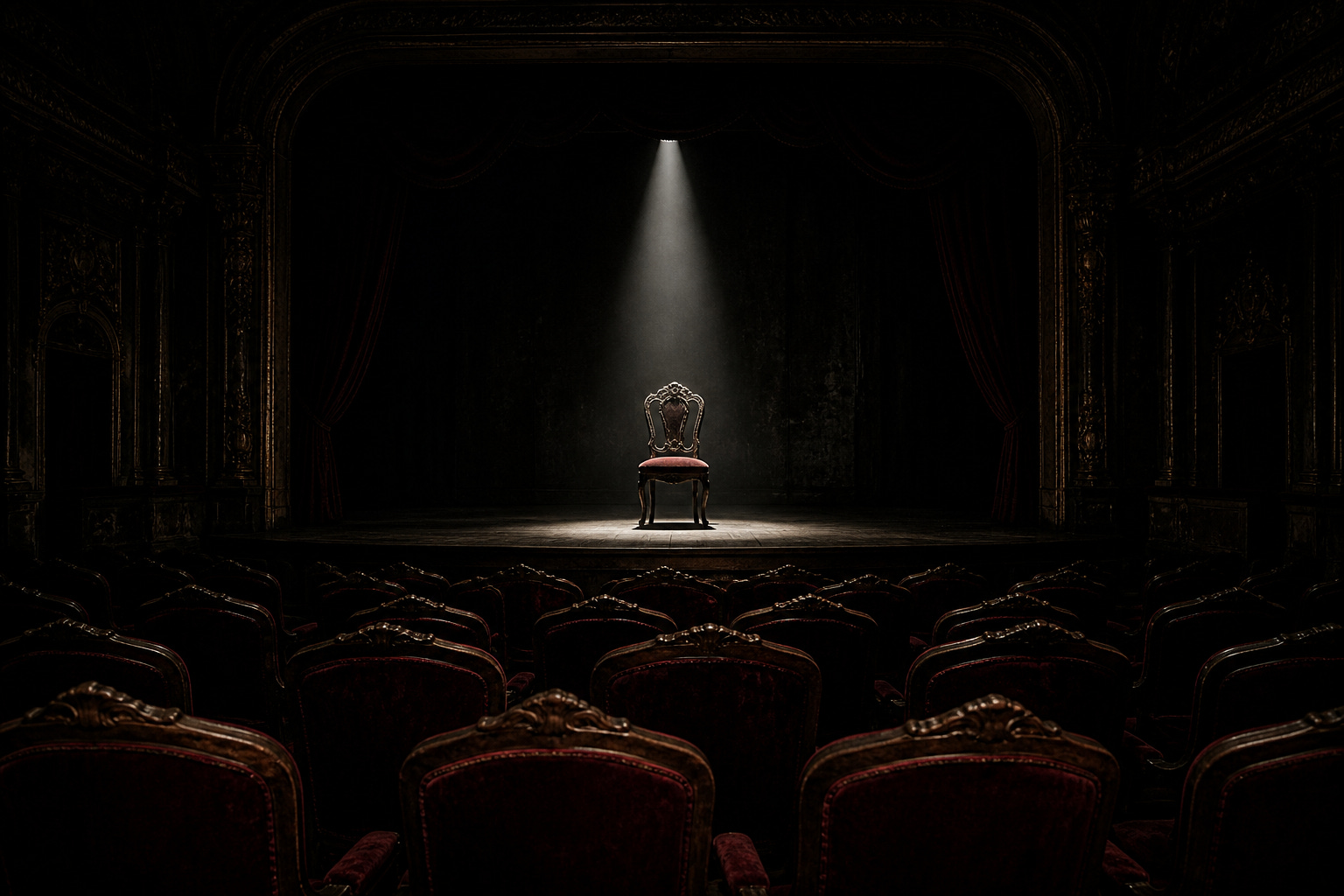
The theater occupied the ground floor of a narrow building on Wyckoff Avenue, but it did not seem to end where it should.
From the street, the windows made the interior appear deeper than the building allowed. It was the sort of place that always appeared slightly older than the surrounding neighborhood, no matter how often the neighborhood reinvented itself. On winter evenings, Elias Mercer found the reflections faintly theatrical.
Elias paused on the sidewalk before entering. He had developed this habit of hesitation in recent months—not fear exactly, but the quiet recognition that certain thresholds, once crossed, lead to conversations he did not enjoy having.
The theater door opened and released a breath of warm air that smelled of dust, paint, and velvet. Elias stepped inside.
The rehearsal space beyond the lobby was small but serious in the way small theaters often tried to be serious. Folding chairs had been arranged in neat rows facing a bare stage framed by black curtains. A work light hung from the ceiling, illuminating the stage in a cone of pale yellow.
Adrian Voss stood near the stage speaking with a cluster of actors. Elias recognized him immediately—Voss possessed the kind of angular enthusiasm that made directors look permanently mid-gesture even when they were standing still. When Voss noticed Elias he broke away from the actors and approached with quick, decisive steps. “Elias Mercer,” he said, extending a hand. Elias shook it. “Adrian Voss.”
“I know who you are,” Elias replied. That was not strictly true—he knew the type—but Voss smiled anyway.
“I’m grateful you agreed to do the notes.”
“Grateful enough to pay me?”
“Within the limits of a nonprofit arts budget.”
“That’s all anyone ever promises.”
Voss laughed, the sound carrying easily in the empty room. “We’re doing something unusual,” he said.
“That tends to be the justification for small budgets.”
“Yes, well,” Voss said, glancing briefly toward the stage. “Unusual is the correct word in this case.”
Elias followed his gaze. The stage itself was bare except for a single wooden chair positioned near the center. The chair faced the audience with a patient stillness that made it look less like a prop and more like a piece of furniture waiting to be used.
“What’s the production?” Elias asked.
Voss hesitated. “The King in Yellow.”
Elias blinked once. “That old thing?”
“You say that like it’s a joke.”
“It’s a literary rumor more than a play.”
“Rumors are theatrical,” Voss said. “They want staging.”
Elias considered the chair on the stage again. “You’re aware the second act doesn’t exist.”
Voss tilted his head. “That’s the traditional claim.”
“And you’re planning to stage it anyway.”
“Yes.”
“How?”
Voss’s smile returned, though this time it carried a faint suggestion of secrecy. “The second act has a way of completing itself.”
Elias waited for the explanation that did not arrive. After several seconds he said, “You’re being metaphorical.”
“Possibly.”
Elias had been a critic long enough to recognize a director enjoying his own mystery. He removed a small notebook from his coat pocket. “You want historical context, I assume. Fin-de-siècle decadence. Chambers. Parisian symbolism.”
“Of course.”
“And something about the mythology surrounding the play.”
“If you like.”
Elias nodded. “That’s manageable.”
Voss gestured toward the stage. “We open in two weeks.”
“Ambitious.”
“I prefer inevitable.”
Elias wrote the word inevitable in his notebook without entirely understanding why.
* * *
Later that night Elias sat at the narrow desk in his apartment, the glow of his laptop illuminating a neat scatter of reference books. Outside the window Brooklyn traffic moved in slow ribbons of white and red light.
He began drafting the program notes.
The King in Yellow first appeared in the 1890s amid the decadent literary movements of Paris and London…
He typed steadily for nearly forty minutes. When he finished the first page he leaned back and reread the text. The prose was competent, slightly elegant, nothing memorable. He saved the document.
The screen flickered.
At first Elias assumed the flicker came from his tired eyes. Then he noticed the new line. It had appeared halfway down the page between two paragraphs. He had not typed it.
The sentence read:
When you hear the bell, do not look toward the balcony.
Elias stared at the line for several seconds. It carried the tone of instruction rather than explanation. He placed the cursor beside it and pressed delete. The line vanished.
He saved the document again and resumed writing. Five minutes later the line had returned—only now it read slightly differently.
When the bell sounds, do not look toward the balcony.
The phrasing was cleaner. More inevitable.
Elias frowned and deleted the sentence again. Twenty minutes passed. Then he noticed the cursor moving—not quickly, not dramatically, just one careful movement across the screen, like a finger adjusting the position of a chess piece.
A new sentence appeared.
You will notice the bell before anyone else.
Elias placed both hands on the desk and listened. The apartment was silent. Yet for an instant—so faint he could not be certain it had happened—he thought he heard something like the distant murmur of applause.
* * *
Elias closed the laptop. When he opened it again, the lines were back.
Two lines. Both improved. Both patient.
When the bell sounds, do not look toward the balcony.
You will notice the bell before anyone else.
He deleted them, then opened the version history: one version only. Document properties: no collaborators, no tracked changes. He tapped the trackpad and typed a new sentence with deliberate care: *This revival arrives to us not as a relic but as a question.* He saved.
The screen flickered. A third line appeared.
You will not call Adrian Voss by his first name.
Elias stared. It was, he admitted reluctantly, correct. He had not called Voss Adrian, even in his head. He would have found it presumptuous, too familiar—a way for Voss to claim the intimacy of collegiality without earning it.
He reached for his phone and made a note: Program notes doc rewriting itself. Adds stage directions. “Balcony.” “Bell.”** Then, beneath it: **Sleep.
By one in the morning he had a complete draft—a smooth historical gloss, a few tasteful references, a nod toward the mythology without indulging it, and then, embedded like something living, those three sentences. He deleted them one final time, exported to PDF, and emailed it to Voss: Draft program notes attached. Let me know if you want more emphasis on the Paris milieu. His tone was professionally casual. It contained no hint of the fact that he felt, faintly, as though he had mailed a letter to a city.
In the bathroom mirror his face looked slightly more resolved than it had earlier, as though some invisible editor had tightened the lines around his mouth.
He was not afraid, not exactly.
What he felt instead was the beginning of a familiar sensation—the quiet recognition that something had already begun to use him.
He had lived through that once already.
* * *
Elias did not intend to visit the gallery that night.
The decision presented itself as a continuation rather than a choice. The theater and the gallery shared a wall; their doors opened onto the same narrow stretch of sidewalk. Leaving one meant passing the other. He told himself he was curious, that it was professional.
The gallery windows reflected the streetlights in the same deep, theatrical way as the theater’s glass, giving both spaces a shared illusion of depth. For a moment Elias saw himself reflected twice—once in each pane—two versions of the same figure pausing before entry. He chose the gallery.
Inside, the air was cooler, thinner somehow, with the faint mineral scent of plaster and old paper. A woman stood behind the desk, reading from a tablet. She looked up as Elias entered.
“We’re closing soon,” she said.
“I won’t be long,” Elias replied. “I’m working with the theater next door.”
Recognition flickered. “Oh,” she said. “The revival.” She hesitated, then added, “You might want to see the back room. We’ve been having a… measurement issue. The dimensions don’t seem to match the plans.”
“Buildings don’t usually gain space,” Elias said.
The woman smiled briefly, acknowledging a joke she did not entirely share. “No,” she said. “They don’t.”
* * *
The storage room lay beyond a narrow hallway that seemed slightly longer than it should have been given the depth of the building. He noticed this only after he had already reached the end of it, the realization arriving a fraction too late.
At first glance, the room was unremarkable: shelving along the walls, crates, wrapped canvases leaning in patient rows. Elias stepped inside and turned slowly, taking in the geometry. Rectangular. Or close enough.
Then came recognition—no shift, no movement, just certainty.
There was an angle that did not belong.
At the far end of the room, where two walls should have met cleanly, there was instead a shallow recess—a fifth plane interrupting the expected four. It was not large. It did not call attention to itself. It simply refused to resolve.
He walked toward it. The recess felt cooler, the light reaching into it without quite settling, producing a faint gradient rather than a shadow.
Inside the recess hung a series of framed sketches. Charcoal on paper. Rough, confident lines. Towers. Arches. Repeating structures that suggested a city seen from multiple vantage points.
The sky in the sketches was wrong. Not empty. Occupied.
Black stars scattered across a field that did not behave like a sky, fixed and yet misaligned, governed by a perspective unlike the one governing the buildings below.
Each drawing was signed—different names, different hands, different dates—the signature placed in the lower right corner with the quiet certainty of completion.
He stopped at the final sketch.
A lake occupied the foreground, its surface rendered in dense, overlapping strokes that suggested movement without direction. Beyond it, the towers rose in layered recession, their geometry precise and impossible, each line both intentional and slightly incorrect. Above them, the black stars.
His attention fixed on the lower right corner: the signature. He leaned in.
The name was written in a hand he knew. Not just recognized. Known. The curve of the M. The pressure on the downstroke. The slight hesitation before the final letter, where the writer had clearly considered—briefly—whether to finish.
Elias Mercer
He studied the mark with a critic’s detachment. Natural density and variance. No sign of tracing.
It was his own.
Behind him, somewhere in the gallery, a floorboard shifted. Elias lowered his hand.
The smell reached him then—not sudden, only present. The faint, unmistakable scent of old velvet.
He stepped backward, out of the recess, and felt—distinctly—the moment his body re-entered the room’s expected geometry, like passing through an unmarked boundary. He turned and left without examining the other sketches again.
* * *
“Well?” the woman at the desk asked when he returned.
Elias considered his answer a moment. “It’s a storage room,” he said.
She studied his face, weighing the adequacy of that description. “Of course,” she said.
Elias nodded once—a gesture that felt like agreement with something neither of them had articulated—and stepped back out onto the street.
The air was colder. He inhaled deeply. The smell of velvet still held. It stayed with him the length of the block, like the afterimage of a performance he did not remember attending. Only at the corner did it fade. He paused there, looked back. For an instant—no longer than a blink—the reflection showed a depth that extended beyond the wall, a suggestion of interior space that did not correspond to any room he had seen.
Something like a balcony.
Elias looked away. He continued home.
That night he dreamed of a theater. Not the one on Wyckoff Avenue, but a larger house with ornamentation he could not have afforded even when he still wrote reviews that mattered. The seats were upholstered in faded velvet the color of old blood. He was alone in the audience. Onstage a single chair faced him—the chair from Voss’s rehearsal space, but older here, more formal.
A bell sounded once.
Elias looked down at his hands and realized he was holding a program. He opened it. The program contained only a single line.
You will notice the bell before anyone else.
He woke with the sentence in his mouth. The apartment was dark. He had slept less than three hours.
A new note had appeared on his phone beneath the one he had written.
When the bell sounds, do not look toward the balcony.
He had not typed it. He deleted the note. It returned before his thumb left the screen.
* * *
On the roof of the science building, Mara Mercer warmed her hands around a paper cup of coffee and tried to pretend she was not cold. She had never mastered the art of looking comfortable while being uncomfortable. The best she could do was look competent. Competence was a kind of insulation.
Around her, the astronomy club members set up with the calm ritual of people accustomed to the night’s indifference. They moved tripods, checked power banks, adjusted eyepieces, and spoke in low voices that turned technical terms into little charms against the vastness.
Mara leaned against the parapet and watched Brooklyn extend below her: a grid of amber light and moving headlights. Somewhere out there, in a building that smelled of old velvet, her brother was writing words for strangers. She had not spoken to Elias in several weeks.
“Dr. Mercer,” someone said behind her.
It was Joon Park, a graduate student who was technically no longer her student, though the university had not yet notified her whether her adjunct contract would be renewed. Joon’s face looked more awake than the time of night justified.
“What’s our star doing?” Mara asked.
“It’s behaving,” he said. “Which is the problem.”
Mara crossed the roof to the main telescope where Joon had mounted the tracking camera. “What time is the next disappearance?” she asked.
“01:43. If it keeps the same cadence.”
Mara glanced at her watch. 01:39. The sky is allowed to be strange, but it is not allowed to be consistent about its strangeness.
Mara checked the tracking feed. A star held steady near the edge of the frame, ordinary.
“Could be a satellite,” one of the older club members said nearby. “A tumbling object.”
“We ran the catalog,” Joon said. “Nothing in that path.”
Mara said nothing. Last week the star had not dimmed or flickered or been obscured—it had simply ceased to exist for exactly fourteen seconds. And in the precise moment of its absence she had smelled velvet, and heard something: a brief, soft applause that did not come from any human throat on the roof. Hallucinations do not coordinate themselves across multiple observers. Or if they do, the coordination is the true anomaly.
Mara watched the feed. 01:42. The star held.
“Ready?” Joon asked.
Mara nodded.
01:43.
The star vanished. Not dimming, not reddening, not flickering. Gone.
Every conversation on the roof stopped at once.
For fourteen seconds, the camera feed showed a blank patch of sky. Mara smelled velvet so distinctly she could almost feel it against her fingertips, that slightly greasy softness that holds dust and time. Someone behind her inhaled sharply. Another person whispered, “Do you smell—”
And then, faintly, from what sounded like a distant balcony, applause. Not wild clapping. Polite, restrained. The kind of applause you give when a scene ends and you are satisfied but not particularly surprised.
Mara found herself standing with her hands half-raised, fingers spread, her body preparing to clap in response. She forced her hands down. The star returned.
No one spoke for several seconds.
The roof exhaled collectively. For a moment, no one spoke. Then the older member who had suggested satellites cleared his throat. “Okay,” he said, sounding like a man who had decided to be practical about the impossible. “We have a repeatable phenomenon.”
“Yes,” Mara said. Her voice sounded steadier than she felt.
Joon looked at the waveform display. “There’s a radio burst again. It’s synchronized to the disappearance. And it’s structured.”
Mara felt something cold settle behind her ribs. “Save it,” she said.
He hesitated, then asked, “Do you want me to do the ASCII thing again?”
She did not want him to. She also did. “Yes,” she said.
Joon opened his script and ran it. Text appeared—not random or garbled. Formatted like a play.
JOON: I have done what you asked.
VOICE: You have done what you always do.
JOON: Who are you?
VOICE: The audience.
Joon swallowed. He looked around, expecting someone to be standing behind him.
Mara leaned closer. The cursor blinked at the end of the last line, then continued.
VOICE: There will be an intermission.
VOICE: Do not leave your seat.
VOICE: Wait for the second performance.
“That’s… the same as last week,” Joon said quietly.
No one touched the keyboard.
The cursor moved again.
VOICE: Hello, Mara Mercer.
Mara’s mouth went dry. No one on the roof spoke her full name casually. No one had typed it into this machine. Joon looked at her, eyes wide.
“I didn’t put that in,” he whispered.
“Check your inputs,” Mara said. “There’s something in the script.” Her voice sounded thinner than she intended.
Then:
VOICE: Watch the balcony.
Mara’s stomach tightened. From the city below, faintly, what sounded like applause. This time it seemed closer.
* * *
Elias spent the day doing the things that made him appear stable. He called Lena at the agreed-upon time and spoke with cheerful calm about school and books and a new pencil case shaped like a cat. He did not mention the lines in his program notes. He did not mention the fact that when he opened the PDF to confirm nothing had changed, it now contained a new sentence on the last page, printed in the same font as the rest.
You will not explain yourself.
At five, Voss emailed back.
*This is excellent. Elegant. Exactly the tone. We’ll print tomorrow.*
Then, as a second line: Do not worry about the balcony. It’s not real until it is.
Elias stared at the message. Before he could type a response, his phone rang.
Mara.
They had not spoken in weeks, but she called without hesitation when something mattered. Elias answered.
“Are you working on that theater thing?” she asked.
“Yes,” he said. “How did you—”
“Elias,” Mara interrupted, and he heard something in her voice that made him sit down. Not panic. Something worse: the tone of a person describing a verified result.
“Do you know what the Yellow Sign is?” she asked.
Elias felt his scalp prickle. “When the bell sounds,” he said slowly, “do not look toward the balcony.”
Mara went very quiet. Then: “Okay. So it’s happening to you too.”
“What’s happening?” Elias demanded.
“We’re tracking a star,” she said. “It’s not variable. It disappears. Completely. On schedule. Multiple instruments recorded it. And there’s a radio signal synchronized to it.”
Elias’s fingers tightened around his phone.
“We decoded it as ASCII,” Mara continued. “It produces stage dialogue. And it addresses whoever runs the decode by name. It said, ‘Hello, Mara Mercer.’ And then it said, ‘Watch the balcony.’”
Elias swallowed. He thought of Voss’s email. It’s not real until it is.
“Do you smell velvet?” he heard himself ask.
“Yes,” Mara said. “During the disappearance. Like an old theater seat. Like someone opened a door.”
Elias closed his eyes. He felt suddenly, intensely, that he was standing in the same story as his sister—that the theater and the roof had become adjoining rooms in a building neither of them had agreed to enter.
“Mara,” he said, “there’s a gallery next door to the theater. A storage room with an extra corner—blueprints don’t match. Inside there are sketches of a city. Ruined. Under black stars.”
Mara did not speak for a full five seconds. Then, quietly: “Carcosa.”
He had not said the name. He had not needed to. The name had been waiting in the space between them.
“Yes,” Elias whispered. “Carcosa.”
“We need to meet,” Mara said.
After he hung up the apartment was quiet. Then, faintly, from another room: *clap… clap… clap…*
The sound stopped. The smell of velvet appeared in his apartment like someone had opened a program and pressed it against his face.
* * *
That evening Elias returned to the theater. He told himself he was there to confirm printing details. He did not tell himself the truth, which was that he needed to see the building again, to confirm it was still a building and not a passage.
The lobby looked as it had before, but the air felt more charged, with the stillness of a building that had been waiting. Voss met him in the rehearsal space.
“What did you mean,” Elias asked, “about the balcony not being real until it is?”
Voss’s smile thinned. He glanced toward the stage where the chair sat. “There are things in theater that become real because enough people agree to see them.”
“That’s metaphor,” Elias said.
Voss shrugged. “Sometimes.”
“I went into the storage room next door,” Elias said. “There are sketches of a city.”
Voss tilted his head. “You shouldn’t have gone in there alone,” he said mildly.
“You knew,” Elias said.
“I know a great many things. Some are useful. Some merely true.”
“Is this part of the production?”
Voss considered him with the patience of someone evaluating a performer.
“Do you know why I asked you? Because you’re good with words. Because you believe words can build worlds. And because you’ve already lost your reputation once. You’re less afraid of losing it again. That makes you braver than you think.”
Voss held his gaze.
Elias swallowed. He thought of the phrase that had haunted him: The Repairer of Reputations. He had always treated it as a clever title. Now it felt more like an address.
“What is this?” he asked.
“It’s a revival,” Voss said. “And it’s an opening. And a rehearsal.”
“For what?”
“For the second performance.”
The words landed in the room with a weight that was not symbolic. Elias stepped backward without meaning to. Voss merely said, very gently, “When you hear the bell, don’t look toward the balcony.”
Elias turned and left.
In the lobby he paused by a new flyer, printed in pale yellow ink.
THE KING IN YELLOW
ONE NIGHT ONLY
Beneath it, in smaller font:
INTERMISSION PROVIDED. PLEASE REMAIN SEATED.
Elias touched the paper. It felt warm, freshly printed. He pulled his hand back quickly and stepped outside. The smell of velvet followed him anyway, polite and inevitable as applause.
* * *
The next morning Elias opened the document. The text was not as he had left it. At first the differences looked minor—a phrase shifted, a sentence restructured. Then he noticed the second-person address.
You will recognize the tone of this passage.
He scrolled.
You, in the third row, will notice the bell first.
The sentence did not belong to the essay. It belonged to something else—a voice that treated a reader not as abstraction but as position. He deleted the paragraph. The cursor returned to the margin. The text reassembled itself behind him. Not dramatically. Patiently.
He printed the pages and laid them across the floor of his apartment, aligning them edge to edge from the desk to the door. The paragraphs formed a pattern—not in the words, but in the spacing, indentation, margins, line breaks. He moved one page slightly to the left. The pattern clarified.
The arrangement resolved into a shape he recognized without having consciously learned it. Angles intersecting at impossible intervals. Curves that suggested completion without closure.
The Yellow Sign.
He understood, in that moment, that the document had not been rewritten. It had been arranged. He crouched and picked up one of the pages. The text on it had changed—not the content, the address.
You will see it if you stand where he stood.
Elias looked down at the space where he had been standing. He did not return to it.
* * *
Mara printed the waveform and spread the pages across her desk. She rotated them, overlaid two prints. A shape emerged—not drawn, not imposed, but implied by the spacing itself.
She knew the shape. Not as knowledge. As familiarity without source.
She searched. The results appeared immediately: illustrations, descriptions, a name. The Yellow Sign. The alignment held. Not symbolic. Geometric.
She photographed it and sent it to Elias. Do you see this?
Three seconds later: Yes.
My document is writing in dialogue.
She typed: It’s behaving like it’s addressing us.
Elias responded: It’s assigning us.
Mara did not correct him.
* * *
Mara arrived at the department early and found Dr. Levin, a careful man inclined toward skepticism not as reflex but as method. She walked him through the observation. He frowned at the sensory details.
“Those are subjective,” he said.
“Yes,” Mara replied. “But they were shared.”
They loaded the telescope recordings. The star held steady in frame, then: absence. Not dimming, not occlusion. A clean subtraction. Levin leaned closer. “Run it again.” Same result. They checked the backup instrument. Same gap. The waveform appeared as a compact burst—structured, periodic, not noise. “That’s not random,” Levin said. “Run the decode.”
Text appeared in dialogue format.
VOICE: You will observe again.
VOICE: You will confirm.
“Run it again,” he said.
The text changed. Specifically.
VOICE: Dr. Levin, you prefer instruments.
Levin went still. He did not speak for several seconds. Then, quietly: “Save everything.”
Mara saved the file. The room smelled faintly of something she could not immediately name. She recognized it a moment later.
Velvet.
* * *
Elias listened to his ex-wife’s voicemail twice before deleting it. Her voice was calm, measured, precise. “The review is in two weeks. They’re going to want to see consistency.”
He looked at the open document. The historical material remained intact. Around it, new lines had appeared. Integrated. Unavoidable.
You will remain for the second performance.
Not a threat. An instruction.
He thought of Lena. Of the hearing. Of the word inevitable, written in his notebook in a hand that now felt less like his own. He opened the laptop again. The document waited. So did the next line.
* * *
The gallery door stood unlocked when Elias returned. The main room was empty. The back hallway felt longer. Enough.
The storage-room light had been replaced with something brighter, more clinical. The recess remained—deeper now, as though it had been given time to consider itself. There were more sketches among the frames. One caught his attention immediately.
The theater, rendered in charcoal, accurate in every exterior detail.
Except—
There was a balcony.
A shallow projection above the entrance, supported by ironwork that curved in precise, decorative arcs.
Elias stared. “There is no balcony,” he said.
The curator nodded. “I know.”
In the drawing, the balcony cast a shadow across the front windows at an angle that made the interior appear deeper. More complete. Elias felt a brief, disorienting certainty that the drawing was not adding something to the building. It was correcting it.
“Has anyone else seen this?” he asked.
“Not everyone,” she said. “Because it’s easier not to point it out.”
Elias nodded. He understood that.
* * *
He opened the laptop and placed the cursor at the beginning of the first anomalous line and typed: Remove this.
The sentence disappeared. In its place, a new line appeared.
ELIAS: Remove this.
Elias froze. He typed again: This is not part of the notes.
ELIAS: This is not part of the notes.
VOICE: It is now.
He added: I am not participating in this.
VOICE: You already are.
Elias closed the laptop. A faint scent. Velvet. He turned slowly. The apartment remained unchanged. The sensation did not. He opened the laptop again. The dialogue remained on screen, unaltered, waiting.
* * *
Mara ran the simulation three times before accepting the result. She adjusted parameters—distance, velocity, occlusion—and nothing reproduced the clean absence recorded by the instruments.
Joon leaned over her shoulder. “What if it’s not being blocked?”
She altered the model: no obstruction, just a positional shift. Not movement through space. Displacement. The star held steady. Then it was elsewhere. The model did not show where—only that the coordinates no longer applied.
“So where does it go?” Joon asked.
“It doesn’t go anywhere,” Mara said. “It stops being where we can see it.”
Joon considered that. “That’s worse,” he said.
Mara did not disagree.
The model did not fail.
* * *
The email arrived without a subject line. No address or even a domain. Only a name.
Program
He clicked. The program notes appeared on screen. Formatted. Clean. Ready. At the bottom of the final page, beneath his name, a new line had been added.
Your seat has been reserved.
After several seconds, a second line appeared.
Please remain seated during intermission.
Elias closed the laptop. The city continued outside, indifferent.
He understood now that the language had shifted. From suggestion to instruction. From observation to assignment.
He stood, crossed the room, picked up his coat. He knew, with a clarity that felt procedural rather than emotional, that the direction had already been determined. Elias opened the door. For a moment, as he stepped into the hallway, he heard it again.
Soft. Measured. Polite.
Applause.
* * *
The line formed before the doors opened. Elias watched it from across the street. People stood with their hands in their pockets, shoulders hunched against the cold, speaking in low voices that suggested anticipation without urgency. They did not look like an audience waiting for something unusual. They looked like people attending a performance they expected to understand.
The balcony appeared in the building’s reflection, clear and fixed. Its ironwork cast a shadow across the glass that aligned with nothing Elias could see directly. The shadow moved when cars passed. The balcony did not.
Elias stepped into line. No one acknowledged him. The doors opened.
* * *
Inside, the lobby held stacks of printed programs arranged with a care that suggested they were not merely informational. Elias took one. The paper felt heavier than he expected. He did not open it until he had taken his seat.
The theater filled gradually. Conversations remained subdued. Elias sat near the middle of the room—he did not remember choosing the seat. He placed the program on his lap and waited.
The lights dimmed slightly. Not fully. Enough.
Elias opened the program. The text was familiar. His text. Refined. Precise. Halfway down the first page, a line appeared that he did not recall writing.
You will notice the bell before anyone else.
Elias did not turn the page. He did not need to. He knew the rest.
* * *
Mara stood in the lobby beneath the skylight. She had not intended to come inside. The plan had been to observe from the roof, to maintain distance, to treat the phenomenon as data rather than participation. The plan had not held.
She checked her watch. 01:42.
Mara did not move. 01:43.
The star vanished. Not in the sky she could see directly. In the reflection. The skylight glass held the image of the night above it, and within that image a single point of light disappeared cleanly, leaving no trace except the absence itself.
Mara inhaled. The smell reached her immediately: velvet, warm and enclosed.
For a moment, she could not remember what she had been about to say.
Behind her, in the theater, the house lights dimmed further. A sound followed. Not loud. Not abrupt. Measured.
Applause.
Mara did not turn. She stood beneath the skylight and watched the place where the star had been. Fourteen seconds passed. The light returned. She turned.
* * *
Elias did not begin clapping. His hands remained on his lap while the audience had already started.
The applause was soft, synchronized without coordination—and slightly out of time with itself. It rose evenly, without hesitation, because the cue had been understood by all present without needing to be given.
Elias looked toward the stage. The curtain remained closed. No performers had entered. No lights had changed.
The applause continued. He became aware, with a clarity that felt procedural rather than emotional, that the audience was not responding to something that had happened. They were acknowledging something that had completed.
He felt the impulse to join them. Not pressure. Alignment. He raised his hands and brought them together once. The sound matched the others. Identical. He did not clap again. He did not need to.
No one looked at him.
The applause reached a quiet equilibrium, then diminished without signal. No one spoke. No one questioned the absence of a beginning.
The curtain lifted.
* * *
Elias did not register the set change as a change. The stage had been empty. Now it contained a street, a lake, and structures that receded into a distance that did not correspond to the dimensions of the room.
He recognized it.
The name arrived a moment later.
Carcosa.
The word did not present itself as discovery. It arrived as confirmation.
Elias stood—not because he intended to leave, but because standing aligned him with what he was seeing. The audience remained seated, their attention fixed forward. Elias moved toward the exit.
The lobby was empty. The doors stood open. He stepped outside.
* * *
The street remained: cars, light, winter air. Elias exhaled.
Then, in the reflection of a parked car, the city shifted. Brooklyn remained. Layered over it, precisely and without distortion, another arrangement appeared. Ruined towers. A sky that did not behave like a sky. Black stars, fixed overhead.
Elias stepped closer. The reflection adjusted. The two cities aligned. Street for street. Line for line. Difference existing only in depth.
Behind him, from within the theater, the applause began again—softer this time, closer.
Elias understood, then, that the distinction he had been maintaining—between stage and street, between performance and observation—had depended on a boundary that no longer held. He turned. The theater doors remained open. Light spilled onto the sidewalk in a shape that suggested invitation without insistence. Elias stood at the threshold. He did not hesitate. He stepped inside.
* * *
His phone vibrated. A message. From Lena.
Where are my seats?
Elias looked up. The audience remained seated. The stage extended beyond itself. The set had deepened. The lake occupied more space than the room could contain. The sky above it held two pale suns.
Elias moved forward.
He saw her then. Lena stood in the aisle several rows ahead, her coat too large for her, her expression calm. She was not looking at him. She was looking upward, toward the balcony.
Elias followed her gaze.
The balcony was there—not reflected or implied.
Present.
Ironwork curving in deliberate arcs. Occupied. Shapes seated in quiet attention.
Elias approached. Lena turned. She did not appear surprised.
“You’re late,” she said.
“I had to finish something,” he replied.
Lena nodded, accepting this. She took his hand. Her grip was steady.
As if she had been waiting longer than he had.
Elias looked at the seats. One was empty. He understood it not as a realization, but as instruction fulfilled. A voice—his own voice—spoke, not aloud, but with the clarity of something already written.
Take your place.
Elias sat. The seat fit. The perspective aligned. The stage no longer appeared distant; it was continuous.
Lena leaned slightly toward him.
The applause rose. Soft and measured. Polite.
The curtain lifted.
Elias did not distinguish between what was performed and what was present. He did not need to. He had already recognized the arrangement.
There had never been a stage.
Only the first audience.
And the second.
The city had been waiting.